

EES Learning Hub Webinar Series

We are excited to announce the launch of the EES Learning Hub, a European platform for cutting-edge workshops and insightful discussions on the latest trends in evaluation. Below are workshops where the facilitators have been happy to share recordings and presentations.
Previous Workshops and Webinars:
Sparking Discussion /Learning Hub FREE Webinar
Date: 13 June 2025 at 15:30 CEST
A powerful 𝗦𝗽𝗮𝗿𝗸𝗶𝗻𝗴 𝗗𝗶𝘀𝗰𝘂𝘀𝘀𝗶𝗼𝗻 𝗱𝗲𝗯𝗮𝘁𝗲 hosted by the EES Learning Hub, which brought together global evaluation foresight and transformation thought leaders. To watch the webinar online, click here.
Implementing an AI-led interview with many respondents
Date: 25 February 2025
Facilitators: Steve Powell and Gabriele Caldas Cabral of Causal Map Ltd
To watch the webinar online, click here and to download a copy of the presentation, Click here.
Sparking Discussion webinar
If you missed our launch Sparking Discussion webinar on November 4th, 2024 “AI in Evaluation: Navigating Ethics, Practical Applications, and Future Directions” you can listen to the recording on the EES website by clicking here.
Emerging Data Landscapes in M&E: Getting Practical with Text Mining in Evaluation: How to Make Sense of Project Information, 15 April 2021
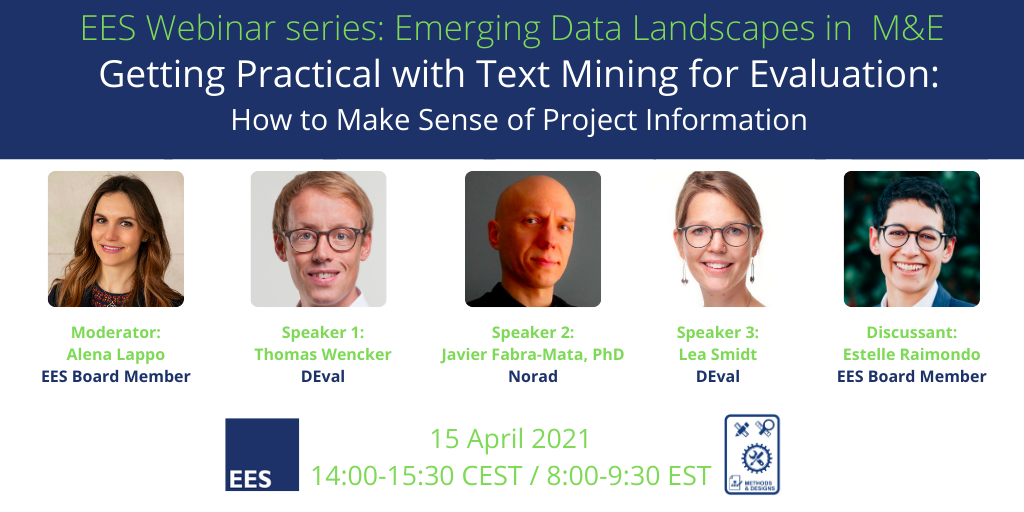
On 15 April EES hosted another event in our online webinar series Emerging Data Landscapes in M&E: Getting Practical with Text Mining in Evaluation: How to Make Sense of Project Information. Co-hosted with Thematic Working Group 6 Methods and Designs, this webinar focused on how evaluators can use text mining techniques to make the most out of the data in project documents and descriptions. While the webinar covered both the conceptual and technical aspects of these methods, the practical focus was on how new users can implement them. Through three case studies from DEval and Norad, the presentations and discussion focused on text mining’s potential, pitfalls, and “how to” tips to get started.
Speaker 1: Thomas Wencker, Evaluator, DEval
Thomas leads evaluations on German development cooperation. His current work at DEval focuses on development cooperation in fragile contexts, patterns of aid allocation, state-capacity building, and dynamics of instar-state conflict.
Speaker 2: Javier Fabra-Mata PhD, Senior Advisor, Evaluation Department, Norad
Before joining the Norwegian Agency for Development Cooperation (Norad), Javier was responsible for the global evaluation & research function at Norwegian Church Aid. Prior to that, he worked for various UN agencies on analysis and evaluation in the fields of international development, peace and security.
Speaker 3: Lea Smidt, Evaluator, DEval
Lea has been working in policy evaluation in the fields of international cooperation and social protection. In her current project at DEval, she has integrated text mining for analysing human rights mainstreaming in Germany’s development policy.
Moderator: Alena Lappo, EES Board Member
An evaluation specialist, Alena has over eight years of experience in analysis and research, most recently for the OECD, the World Bank IEG, FAO’s Independent Office of Evaluation and IFAD.
Discussant: Estelle Raimondo, PhD, EES Board Member
Estelle is an evaluation methods expert who leads evaluations of international development programs and trains teams on a wide range of evaluation methodologies. She is a faculty member of IPDET and adjunct faculty at the George Washington University.
Recording: EES Webinar: Getting Practical with Text Mining in Evaluation
TWG 7 - Quality of Life as an Evaluation Criterion, 10 & 11 February 2021
EES’ TWG 7 on EU Policies was holding its first workshop with the Czech Evaluation Society and the Ministry of Regional Development of the Czech Republic to discuss the quality of live as an evaluation criterion.
For a detailed programme, please download the attachment.
Recording:
EES Webinar Series: Evaluation in Turbulent Times: Navigating the Evolving Big Data Ecosystem - 18 & 19 January 2021
Abstract:
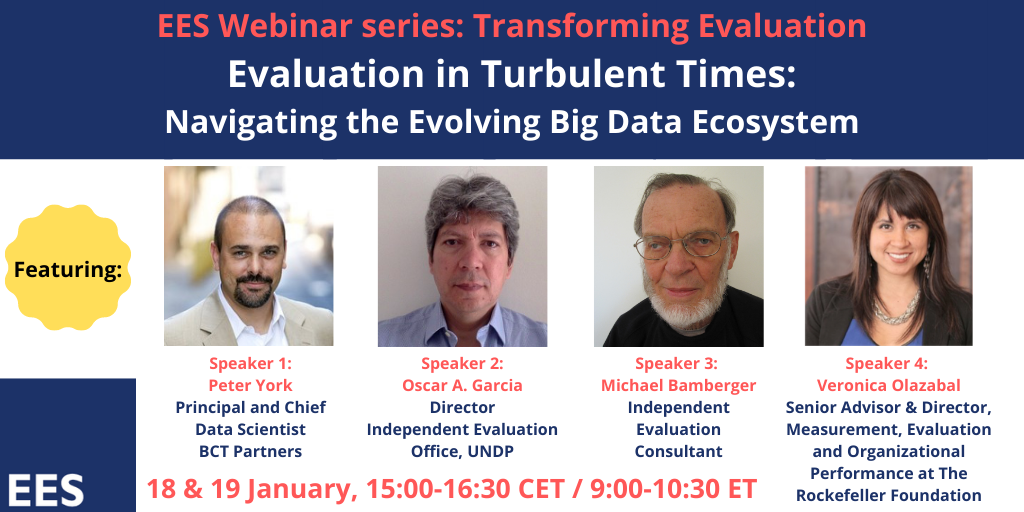
This panel of evaluation leaders will review cutting edge data science technologies for exploiting the huge volumes of increasingly diverse data generated by government agencies, donors, research institutions and non-profits, and examine the methodological, organisational, political and ethical challenges facing evaluators as they transition to the big data ecosystem. The panel will also discuss the organisational and strategic challenges facing evaluation offices as they adapt to the rapidly changing data landscapes and will draw lessons from how evaluation activities are already being restructured to address the challenges of Covid-19.
Speakers:
Panelist 1: Peter York, Principal and Chief Data Scientist, BCT Partners:
Peter has over 20 years of experience as an evaluation consultant and researcher. For the past 8 years he has built predictive, prescriptive and causal evaluation models using large administrative data sets and machine learning algorithms in fields such as child welfare and workforce development.
Panelist 2: Oscar Garcia, Director, Independent Evaluation Office, UNDP:
Before joining UNDP, Oscar was the Director of the Independent Office of Evaluation of the International Fund for Agricultural Development (IFAD). With more than 25 years in the field of development cooperation, he is the author of several books and papers on development evaluation.
Panelist 3: Michael Bamberger, Independent Evaluation Consultant:
Michael possesses over 40 years of experience evaluating development programs around the world. He has been working for the past few years on opportunities and challenges for the integration of big data into the monitoring and evaluation of development programs. He also works on complexity-focused evaluations and how data science can strengthen these evaluations.
Panelist 4: Veronica Olazabal, Senior Advisor & Director, Measurement, Evaluation and Organizational Performance, The Rockefeller Foundation and President-elect, American Evaluation Association (AEA):
Veronica is an award-winning evaluator with a global portfolio ranging +15 years. She serves on various funding and advisory boards and has published on this topic in Evaluation.
Recording:
Presentation:
Transforming Evaluation: Evaluation for the Good Anthropocene - 17 December 2020
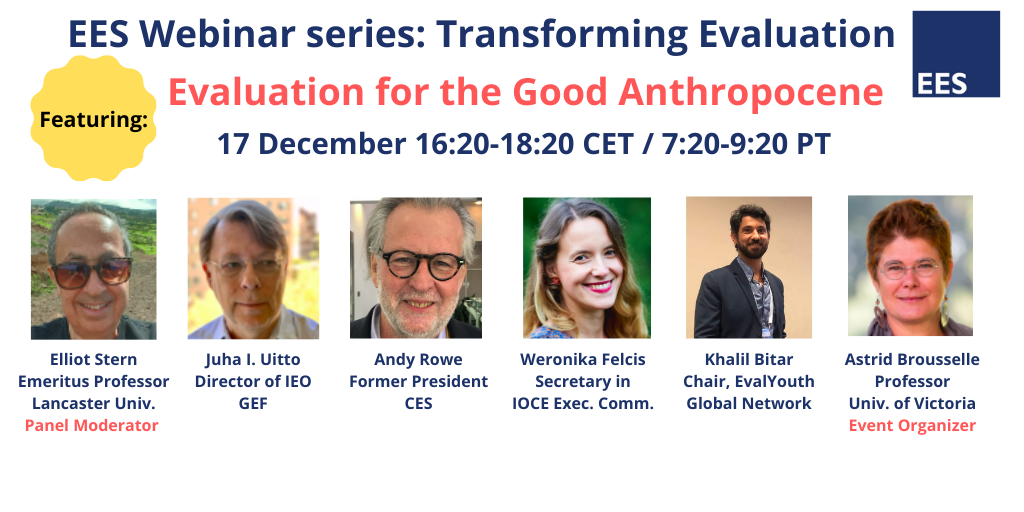
Contributing to the good Anthropocene involves changing our relation to natural and human systems to foster ecological balances that would preserve life and biodiversity but also to create inclusive, equitable and resilient communities. How can evaluators contribute to this agenda? What approaches and frameworks can support evaluators in changing practices? What are promising approaches for the good Anthropocene? This event will be organized around short presentations including a period for live discussions and questions. Join us to make a divergence in these challenging times!
Recording:
Emerging Data Landscapes in M&E Webinar Series: Geospatial, location and big data: Where have we been and where can we go? - 28 July 2020
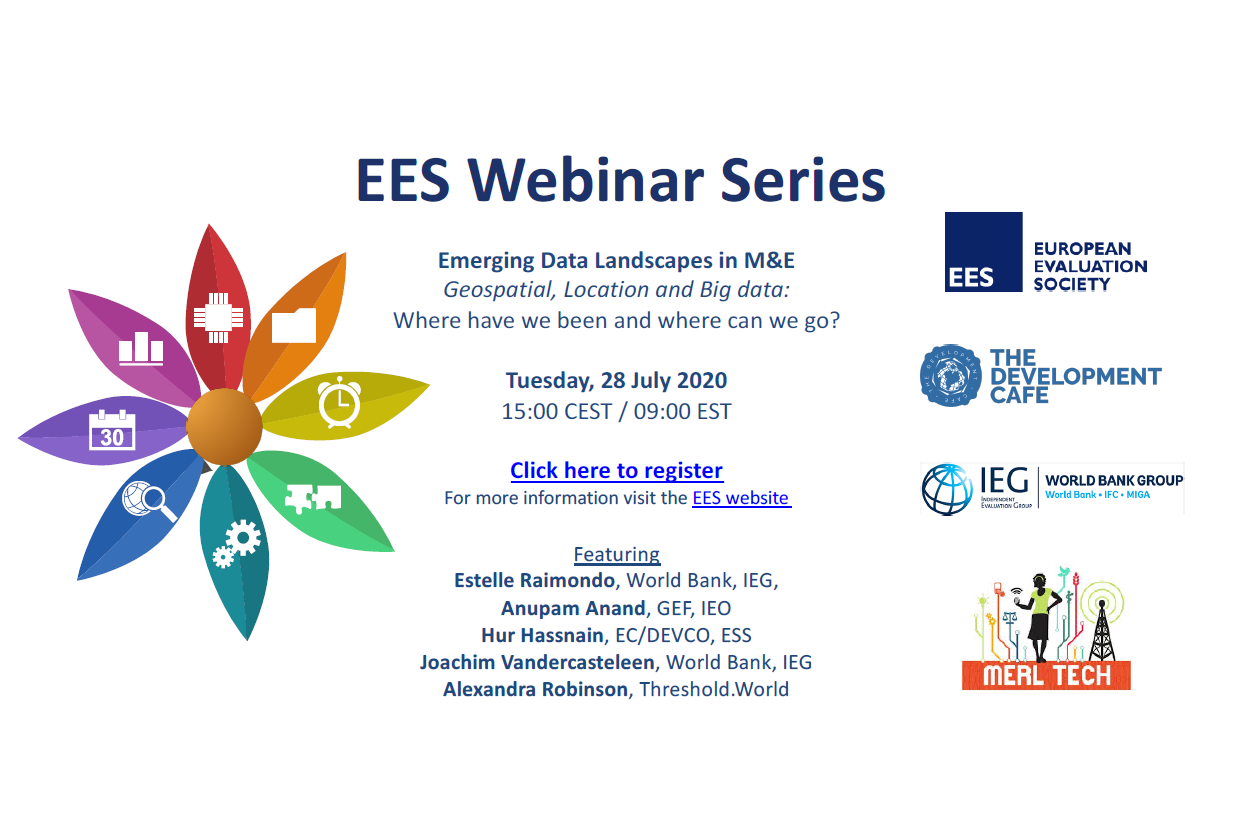
To launch EES’ webinar series “Emerging Data Landscapes in M&E” that will focus on innovative technologies in the world of evaluation, EES is proud to partner with Dev CAFÉ, MERL Tech, and the World Bank IEG on our first event “Geospatial, location and big data: Where have we been and where can we go?”
This interactive and free webinar will feature speakers from the World Bank IEG, the European Commission’s DEVCO/ESS, and the Global Environment Facility, who will provide concrete examples of using geospatial and location data to improve our M&E practices. It will also discuss the barriers to using such technologies and brainstorm on ways to overcome them, by inviting feedback and questions from the online audience.
Recording:
EES Webinar Series: Evaluation in Turbulent Times: Navigating the Evolving Big Data Ecosystem - 18 & 19 January 2021
Abstract:
This panel of evaluation leaders will review cutting edge data science technologies for exploiting the huge volumes of increasingly diverse data generated by government agencies, donors, research institutions and non-profits, and examine the methodological, organisational, political and ethical challenges facing evaluators as they transition to the big data ecosystem. The panel will also discuss the organisational and strategic challenges facing evaluation offices as they adapt to the rapidly changing data landscapes and will draw lessons from how evaluation activities are already being restructured to address the challenges of Covid-19.
Speakers:
Panelist 1: Peter York, Principal and Chief Data Scientist, BCT Partners:
Peter has over 20 years of experience as an evaluation consultant and researcher. For the past 8 years he has built predictive, prescriptive and causal evaluation models using large administrative data sets and machine learning algorithms in fields such as child welfare and workforce development.
Panelist 2: Oscar Garcia, Director, Independent Evaluation Office, UNDP:
Before joining UNDP, Oscar was the Director of the Independent Office of Evaluation of the International Fund for Agricultural Development (IFAD). With more than 25 years in the field of development cooperation, he is the author of several books and papers on development evaluation.
Panelist 3: Michael Bamberger, Independent Evaluation Consultant:
Michael possesses over 40 years of experience evaluating development programs around the world. He has been working for the past few years on opportunities and challenges for the integration of big data into the monitoring and evaluation of development programs. He also works on complexity-focused evaluations and how data science can strengthen these evaluations.
Panelist 4: Veronica Olazabal, Senior Advisor & Director, Measurement, Evaluation and Organizational Performance, The Rockefeller Foundation and President-elect, American Evaluation Association (AEA):
Veronica is an award-winning evaluator with a global portfolio ranging +15 years. She serves on various funding and advisory boards and has published on this topic in Evaluation.
Recording:
Presentation:
Transforming Evaluation: Evaluation for the Good Anthropocene - 17 December 2020
Contributing to the good Anthropocene involves changing our relation to natural and human systems to foster ecological balances that would preserve life and biodiversity but also to create inclusive, equitable and resilient communities. How can evaluators contribute to this agenda? What approaches and frameworks can support evaluators in changing practices? What are promising approaches for the good Anthropocene? This event will be organized around short presentations including a period for live discussions and questions. Join us to make a divergence in these challenging times!
Recording:
Emerging Data Landscapes in M&E Webinar Series: Geospatial, location and big data: Where have we been and where can we go? - 28 July 2020
To launch EES’ webinar series “Emerging Data Landscapes in M&E” that will focus on innovative technologies in the world of evaluation, EES is proud to partner with Dev CAFÉ, MERL Tech, and the World Bank IEG on our first event “Geospatial, location and big data: Where have we been and where can we go?”
This interactive and free webinar will feature speakers from the World Bank IEG, the European Commission’s DEVCO/ESS, and the Global Environment Facility, who will provide concrete examples of using geospatial and location data to improve our M&E practices. It will also discuss the barriers to using such technologies and brainstorm on ways to overcome them, by inviting feedback and questions from the online audience.